Northwest Coast carving is more than an art form; it is a living narrative carried in cedar, copper, paint, and song across communities from the Salish Sea to Haida Gwaii and beyond. Each curve and junction speaks an ancestral language that ties families to their histories, lands, and waters. In cities and towns along the Pacific—including Semiahmoo territory (White Rock), South Surrey, the Fraser Valley, and the greater Vancouver area—carvings appear in public spaces, cultural centers, and private homes as expressions of identity, welcome, and remembrance. Whether you are a local buyer, a curator, or a visitor learning for the first time, understanding materials, design systems, and cultural protocols will deepen your appreciation for these remarkable works and guide you toward genuinely authentic pieces that honor their makers and Nations.
Design Language and Materials of Northwest Coast Carving
At the heart of Northwest Coast carving is a sophisticated visual grammar known as the formline. This artful framework organizes shapes and energies, guiding the eye around the contours of beings such as Eagle, Raven, Bear, Wolf, Hummingbird, Salmon, and Thunderbird. The grammar’s core shapes—ovoid, U-form, and S-form—connect like flowing currents, defining bodies, joints, and plumage. The ovoid often frames eyes and joints, while U- and S-forms provide articulation and movement, ensuring that figures breathe with harmony and balance. For Coast Salish artists, circular rhythms, spindle-whorl inspired geometry, and negative space articulate teachings with equal elegance, often emphasizing motion and relationships.
Material choices carry deep cultural resonance. Western red cedar is revered as the “Tree of Life,” central to poles, masks, bentwood boxes, canoe hulls, house posts, and panels. Yellow cedar, fine-grained and fragrant, excels in precise detailing, while alder, yew, and maple each offer distinct carving characteristics. Historically, pigments derived from charcoal, ochre, graphite, and clay minerals were bound with fish eggs or plant oils to create the black, red, and green-blue palettes seen across Nations, with abalone shell and opercula occasionally inlaid for shimmer. Contemporary carvers may employ modern paints and finishes while staying faithful to hereditary designs or innovating within tradition.
Tools shape both process and outcome. Adzes—differentiated into gutter, elbow, and straight varieties—remove stock and smooth surfaces with rhythmic precision. Crooked knives and straight blades refine edges and forms, while steaming techniques transform a single cedar plank into a seam-free bentwood box through careful scoring and folding. Sanding, burnishing, and oiling complete the work, revealing grain patterns that contribute to narrative depth. Skilled carvers read the cedar before ever striking it, orienting growth rings for strength, aligning knots with intended motifs, and anticipating the wood’s expansion and contraction over seasons. The result is a union of design language, ancestral knowledge, and material intelligence—art whose logic is as functional as it is spiritual.
Cultural Protocols, Meaning, and the Role of Carvers
Every carved piece exists within a web of relationships. Among Haida, Tlingit, Tsimshian, Nisga’a, Heiltsuk, Gitxsan, Kwakwaka’wakw, Nuu-chah-nulth, and Coast Salish peoples, visual rights to particular crests and stories are inherited or granted, not simply chosen. This is why authenticity depends not just on technique but on cultural protocol—who can carve which beings, which stories are public, and which require permission or ceremonial context. House frontal poles, memorial poles, and mortuary poles are not generic “totem poles”; each marks a distinct purpose, from welcoming guests to commemorating leaders. Carved house posts embody the backbone of community, literally holding space for gatherings, teachings, and ceremony.
Masks, rattles, feast bowls, and dance regalia also occupy specific roles in potlatch proceedings and winter dances, and they are often awakened through song and movement. The gesture of a mask—its articulated jaw, its transformation mechanics—carries teachings that live in performance rather than display alone. In Coast Salish territories, spindle whorls carved with salmon, moon, or guardian motifs speak to weaving lineages and the continuity of matrilineal knowledge, symbolizing creation, sustenance, and responsibility.
Today’s carvers hold multiple responsibilities: cultural stewardship, mentorship, innovation, and community service. Many artists blend classical formline with contemporary materials or site-specific installations, collaborating on public art across the Lower Mainland and Vancouver Island. Revitalization efforts—from language resurgence to ceremonial restoration—often center on carving, a practice that re-threads ancestral knowledge into modern life. Where communities historically faced bans and disruptions, artists now lead cultural renewal, creating works that honor elders, guide youth, and educate the broader public about protocols and history.
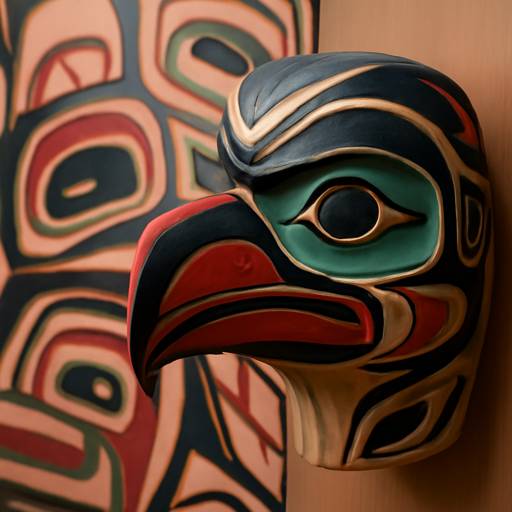
Respectful engagement means recognizing that Northwest Coast carving is inseparable from family rights, teachings, and place. For those seeking to learn or collect, the best path is to support artists and Native-owned galleries that can contextualize a work’s origin, permissions, and significance. This is especially true in localities like Semiahmoo territory (White Rock) and South Surrey, where public artworks, cultural events, and exhibitions offer pathways to learn from community voices firsthand.
Collecting, Commissioning, and Caring for Authentic Northwest Coast Carvings
Acquiring authentic carvings begins with clear provenance. Look for the artist’s name, Nation, and, when applicable, the crest or story with its permissions. Documentation should outline materials—such as red or yellow cedar, yew, alder—alongside finishes and inlays. When you purchase through an independent, Native-owned gallery or trading post, you gain informed guidance about cultural context, care instructions, and fair compensation for the artist’s labor and knowledge. For those browsing online, a trusted source for northwest coast carving can provide biography details, community connections, and transparent return and shipping policies across Canada and the United States.
Commissioning a piece is an opportunity to participate in a living tradition with humility and clarity. A typical process includes an initial consultation to discuss intent, location, size, budget, and timeline; a conversation about rights and imagery (for example, whether a salmon cycle, Raven, or family crest is appropriate); a sketch phase; and a contract covering delivery, installation, and insurance. Lead times vary by scale—from a few weeks for a small mask to many months for a house post or pole. For homes and public spaces in the White Rock, South Surrey, and Fraser Valley areas, carvers consider sightlines, lighting, and environmental exposure. Exterior cedar works benefit from breathable finishes and overhangs; indoor pieces prefer stable humidity, indirect light, and gentle dusting with a soft cloth. Avoid aggressive chemicals, prolonged direct sunlight, and uncontrolled heat sources that could crack or warp the wood.
Consider a real-world scenario: a community center in South Surrey seeks a welcoming panel that reflects local waters and salmon runs. The project team engages an artist with Coast Salish lineage, ensuring imagery aligns with place-based teachings. The carver sources a single slab of red cedar, develops a flowing design where U-forms echo river currents, and integrates abalone inlay to suggest scales in moonlight. Installation includes community education, acknowledging territorial lands and the cultural intent behind the panel. This process—intent, permission, collaboration—produces a work that is not only beautiful but also accountable to community and land.
Collectors furnishing homes or curating exhibitions in the Vancouver and Fraser Valley region can also explore pieces suited to modern interiors: small-format masks, paddle pairs for narrow corridors, bentwood boxes for entry consoles, and relief panels scaled for stairwells. Lighting at a 30–35-degree angle reveals carving depth without glare, while neutral wall tones let the black-red-green palette or natural cedar tones breathe. When displaying multiple works, allow each carving “negative space” to preserve visual integrity—mirroring the formline principles embedded in the art itself.
Finally, authenticity intersects with ethics. Buying directly from artists or Native-owned businesses helps sustain apprenticeships, family studios, and ceremonial economies that keep traditions strong. It also counters mass-produced imitations that can misrepresent teachings and divert support. In places like Semiahmoo territory (White Rock), long-standing relationships between artists, cultural organizers, and galleries have fostered exhibitions and cultural vending at conferences and community events—pathways that connect informed buyers with genuine works. For museums, gift shops, and hospitality venues seeking wholesale, partnering with teams that prioritize accurate provenance and cultural guidance ensures respectful representation and enduring value.
From the steady swing of the adze to the final burnish that brings cedar grain to life, Northwest Coast carving carries a continuity that is both ancient and forward-looking. By learning the design language, honoring protocols, and supporting authentic makers and Native-owned galleries, collectors and communities can help the lines of this art form remain alive—breathing wisdom into homes, public spaces, and the next generation.

Beirut architecture grad based in Bogotá. Dania dissects Latin American street art, 3-D-printed adobe houses, and zero-attention-span productivity methods. She salsa-dances before dawn and collects vintage Arabic comic books.